THE MILITARY CALLS US FOR SUPPORT
…BUT THEY’RE TEACHING US

Article by: John Scardena
President of Doberman
April, 9, 2026
U.S. military and NATO forces utilize the Doberman team as subject matter experts to support training, define and refine doctrine, and identify operational improvements. Mr. Scardena built this capability by demonstrating the operational crossover between emergency management and military operations. This article explores what he’s oberserved through this process and how those lessons can strengthen the field of emergency management.

EMERGENCY MANAGEMENT
BEYOND EMERGENCY MANAGEMENT
Leaders crave next-level emergency management. I have been proving that for years by applying EM principles to other industries like the U.S. Military and NATO Forces with incredible success. This niche has been exciting because it proves that stakeholders need the strengths of emergency management—not how it’s typically done, but how it should be done. A CEO or 3-Star General doesn’t care about an Incident Action Plan. What they care about is life, property, and often—most importantly—continuity. They care about winning.
Emergency management, when applied this way, identifies real issues, builds process around realistic solutions, and ultimately helps them succeed. The problem we see too often in the field of EM—for many reasons, some beyond your control—is that issues are not adequately identified, process becomes a burden of task saturation, and success is often left to others with more authority. All of that needs to be addressed.
That is what next-level emergency management is about.
When a client hires us, we put heavy emphasis on fixing those problems. We demand the ability to run in order to properly support the mission. What they get are huge wins. It’s shocking to the field of EM, but not a shock for most other industries. They get it because that’s how they operate—and how they expect us to operate. We break our own culture by acting like the “management” team that others anticipate.
Ever feel like you’re disappointing a stakeholder, but can’t figure out why?
Maybe it’s because you’re confusing them with a process that doesn’t match what’s anticipated.
We still love supporting proven and traditional EM projects like EOPs, LHMPs, HVAs, mass care plans, alert and warning policy, etc.; we’ve also drastically expanded into areas like supporting executives with crisis leadership, security by design, marketing, and military operations—to name a few. Emergency management principles apply across the board. For example, I believe that if a politician hired a team of emergency managers to run their campaign, they would be unstoppable.
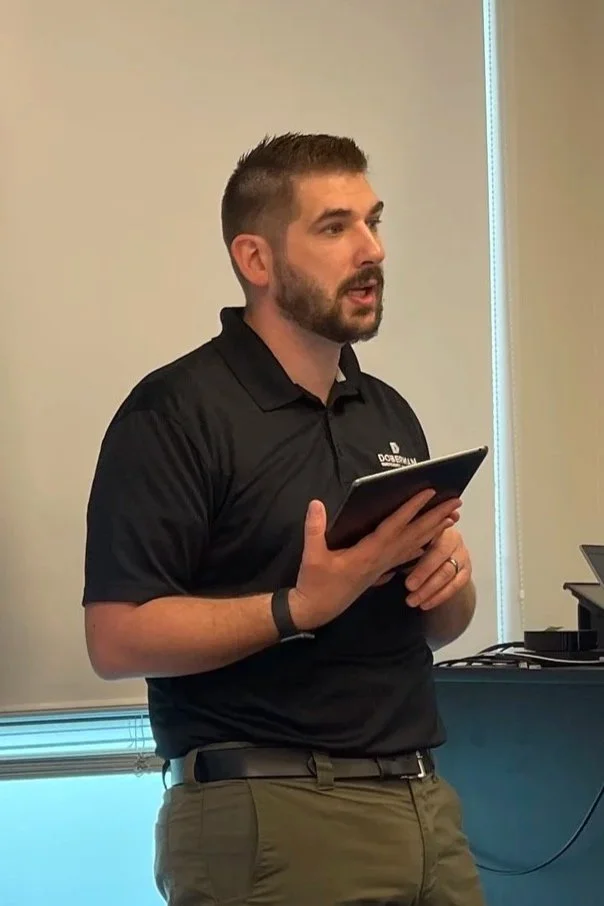
Due to this ability to expand beyond standard EM projects, my work has little to do with emergency management “tasks,” but everything to do with the mission of emergency management. Honestly, it’s one of our superpowers at Doberman—and a big reason why we continue to dominate.

EMERGENCY MANAGEMENT
& THE MILITARY
Next week, for example, my team of emergency managers will be providing a doctrine gap analysis for urban warfare operations. On a personal level, that’s both exhilarating and fills me with a major sense of pride. We are helping organize efforts for the most complex disaster type on earth. War is a disaster—take that any way you would like. And if it is a disaster, emergency management is crucial to the enhancement of threat mitigation, response, and recovery. The warfighter and civilian are better off because of us.
What’s even more exciting than providing training is working with military personnel who embrace emergency management frameworks. That, quite frankly, shows their desire to innovate, “to be the best that they can be.” Unfortunately, most emergency managers...and certainly many of our so-called “competitors in EM”—have a complete lack of understanding of how to apply one to the other. They miss out, and so do survivors, because of that inability to connect the dots.
This isn’t just a creativity issue. It’s analytics, data, research, and capacity. I don’t blame anyone for this. It’s inherent in any professional setting for most people to operate within existing lanes. A few can see that flying is better than driving. And even more rare is the ability to apply those changes. Most who dream about flying cannot—and should not—build the plane.
A true visionary needs more than a dream. They need practicality, resources, assets, an understanding of design and infrastructure (or the ability to build it), and many long nights with little support until they gain traction and build the right team. That perspective has shaped how I evaluate execution—and why I pay close attention to those who operate at a high level.
I’ve never been in the military. I’m proud of the path I chose. Emergency management is special to me. But as a civilian working alongside military counterparts, I am both inspired by them and consistently struck by one thing: Their organizational process around operational tempo.
The military, as a system, has spent thousands of years refining how to operate, organize, and execute—especially in austere, high-risk environments. They are built for action. Built for command and control. Built to move.
And they show up in disasters all the time—supporting Emergency Support Functions (ESFs) like Transportation, Public Works (e.g., USACE), Logistics, and more. They are, quite literally, the largest aid provider on Earth.
Many of these characteristics apply directly to emergency management. Yet, we continue to miss out on a wide range of proven tactics, techniques, and procedures (TTPs)—a concept deeply embedded in military operations—that could significantly enhance how we work.
WHAT WE CAN TAKE FROM THE MILITARY
Here are a few concepts from the military that can be applied directly to emergency management which will drastically improve current frameworks, like the planning process. These are discussed in more detail on the Disaster Tough Podcast Season 7, Ep. 261.
ASCOPE (understanding the environment through community lifelines)
Areas, Structures, Capabilities, Organizations, People, and Events. This has significant value when applied to community lifelines. Instead of looking at lifelines in isolation, it forces you to understand the environment they operate in. This will improve how you brief, how you explain your position, and your ability to clearly articulate what you need. It also allows you to identify issues faster and understand the true scale of problems. When applied this way, ASCOPE supports Community Lifelines as a operational tool framework.
3-Block War (organizing effort across ESFs and lifelines)
The concept recognizes that multiple missions must occur simultaneously in the same operational space. Emergency management faces this exact reality, but we rarely organize around it. We typically say, “life-saving, life-sustaining,” but this misses our core relationship to all other Emergency Support Functions- as the strategic coordinator in the protection of life, property, and continuity of operations. Because Doberman works with NATO frequently, we look at Block 1 as conventional. Some U.S. doctrine for military puts Block 3 as conventional. For this article, what we are describing is mission grouping, rather than a literal 3-block requirement.
Block 1: Lifesaving response ops
For the military, this is organizing and conducting conventional warfare—engaging the threat. For emergency management, this is organizing large-scale life-safety operations through traditional services—fire, law enforcement, EMS, and search and rescue—addressing the disaster directly for the purpose of saving lives.Block 2: Support, protection, and sustainment
For the military, this includes defense and sustainment of operations. For emergency management, this is the strategic coordination, support, and protection of all Emergency Support Functions—from logistics and infrastructure to MOUs, financial frameworks, and continuity of operations.Block 3: Community support and stabilization (life-sustaining and recovery)
For the military, this is civil-military operations and humanitarian support. For emergency management, this is direct support to the community through programs and organizations that keep people out of harm’s way, stabilize conditions, and set the foundation for recovery and normalization.
These blocks should not be sequential. They should be happening at the same time.
J-Structure (intelligence and operations alignment)
The military separates key functions to improve clarity and performance. Intelligence (J2) is responsible for gathering and analyzing information, while operations (J3) is responsible for planning and execution. Emergency management often blends these functions or leaves gaps between them. Aligning intelligence and operations improves situational awareness, decision-making, and speed of execution.
Organizational Scaling structure
The military organizes around size, scale, and capability. Roles, responsibilities, and reporting structures are clear and aligned to mission requirements. Emergency management is far less consistent: structures often vary by organization, personality, or circumstance. At times, even national-level teams report through regional structures, creating unnecessary friction and confusion.
Organizing by capability and scale—rather than personality—creates clarity, improves coordination, and strengthens execution. Advancement should follow the same principle. Roles should expand with demonstrated capability, not just tenure or position.
This is not about replicating a military structure. It is about applying the parts that work—clear scaling, defined roles, and aligned responsibility—while maintaining the flexibility and hiring practices that make the private sector effective.
Clearly other emergency services have adopt similar models, titles, and roles. The Fire Service, Emergency Medical, and Law Enforcement all use this structure, while preserving best practices in hiring and seeking great talent.
PROCESS BY DEFAULT
NOT BY DESIGN
THE PROBLEM WITH
“FIXING” FEMA
AND THE FIELD BY EXTENSION
We talk a lot about change in emergency management. We hear phrases like “changing EM” or “FEMA needs to improve.” But what I consistently see however, is an effort to fix systems that were never particularly strong to begin with.
Stop-gap solutions are necessary in every organization. The best organizations understand their purpose and lifecycle. Poorly managed systems forget the why—and turn stop-gaps into permanent processes.
We are long past the point where incremental adjustments are enough. Some processes need to fade into the sunset. In their place, we should adopt proven practices that enhance our ability to manage the disaster lifecycle—not just document it, coordinate it, or talk about it.
Through Disaster Tough Podcast (DTP), I’ve been exploring these ideas with leaders in EM and across industries. Many of these concepts are not only validated—but expanded—by experts pushing boundaries in their fields.
As you hear more about Individual Assistance, Public Assistance, the Stafford Act, NFPA, PKEMRA, IAPs, IMATs, State Liaisons, and the countless policies, doctrines, and structures that shape our field, it’s worth pausing to ask a different set of questions.
Was this a stop-gap—or was this always the plan and now we need 2.0?
Was this an experiment?
What data, influence, or problem informed its creation?
Are we improving a proven process that strengthens the strategic coordination of emergency services in the protection of life, property, and continuity of operations?
Or are we fixing something simply because it exists?
Who benefits from it? Who does it burden? Why?
Do the tasks required to complete it actually matter—and for how long?
Does it matter because it is mission-critical—or because we are simply accustomed to doing it?
At what level of the organization does the purpose get lost? At what level does leadership stop understanding—or stop caring?
And perhaps most importantly: do I understand—and can I clearly define—the purpose of this task as it applies to the mission and definition of emergency management?
These are necessary questions to help us understand priority and impact of new or existing programs.
Emerging Concepts & The Innovation Cycle
As new ideas are developed—whether by you or by others—remember that systems, processes, and trends come and go. Do not let every new concept or rumor become a source of stress before it is part of your work. And when something does become part of your job, the obligation changes.
At that point, you should actively prove it, improve it, or disprove it through practice. Collect enough data to understand it. Do not dismiss or embrace anything without giving yourself enough time and evidence to act with clarity and judgment.
Then do it again.
That is the innovation cycle.

WHAT EMERGENCY MANAGEMENT
ALREADY GETS RIGHT
LOOKING BEYOND
THE MILITARY
The conflict in Iran, as well as any military operations, reinforces something I’ve believed for a long time: the military offers a great deal in this space—particularly in intelligence, planning, and operational execution. But they are not the only example.
There is just as much to learn from other industries.
Technology offers speed, iteration, and data-driven decision-making.
Finance offers risk modeling and structured decision-making under uncertainty.
Aerospace brings systems thinking, precision, and a long-term view of complex operations.
We should be learning from them just as much as they can learn from us.
It’s equally important to recognize that our field brings unique strengths—many of which other industries struggle to replicate. To name a few:
Coordination and collaboration as a process for planning.
The Planning P.
Our ability to solve complex problems.
Our understanding of long-term cycles of change.
How we structure responsibilities through ESFs and Community Lifelines.
These are powerful capabilities. When applied correctly, they extend far beyond our field.
We also have one of the most meaningful missions anyone could ask for. That mission alone is what keeps many of us going.
The War in Iran episode from the Disaster Tough Podcast breaks down a few of these crossover concepts that will help you plan, act, organize, and explain more effectively. When applied together, these ideas lead to one outcome: Helping more people—more efficiently.
Emergency management has a powerful foundation and an even greater opportunity ahead. When its principles are applied with clarity, structure, and intent, they extend across industries, strengthen leadership, and improve outcomes at every level. By building on what works, adopting proven approaches, and continuing to evolve how we operate, we position the field to lead in any environment. At its best, emergency management identifies real problems, organizes effective solutions, and helps people succeed.
If we take an honest look at how this field has evolved, our policies and practices did not emerge from a single, deliberate design—they were shaped over time by a consistent set of influences. Some are rooted in operational success, others in compliance and risk management, and others in the realities of how organizations staff and sustain their work. Each influence makes sense on its own. Together, they define how we operate today.
Reality check—from best to worst:
Fire (operational lineage through ICS / NIMS)
Legal (compliance, documentation, and audit requirements)
Past incidents (lessons learned through AARs, often created in a vacuum)
Leader discretion on “good ideas” (legacy practices carried forward over time—some good, some bad)
Risk posture (prioritizing defensibility and consistency)
Workforce dynamics (personnel entering the field in high-level positions without operational grounding, shaping process toward personal stability)
Incentives (individuals or organizations prioritizing pay over mission)
These aren’t all inherently bad sources—but they are limited. And when they become the dominant drivers of how we operate, they constrain capability.